Imaging remains one of the most vital tools in modern medicine, offering detailed insights that guide diagnoses and treatment plans. For radiology technologists, keeping pace with the evolution of imaging technologies is essential to delivering outstanding patient care.
Among the latest advancements, Quantitative Whole-Body MRI stands out as a transformative innovation, shifting MRI from isolated, static images to a comprehensive, data-rich evaluation across the entire body in a single session.
How Quantitative Whole-Body MRI Redefines Diagnostic Imaging?
Traditional MRI scans generally focus on specific anatomical regions, such as the brain, spine, or joints, requiring separate sessions to assess different parts of the body. While effective for targeted evaluation, this segmented approach has limitations, especially when broader, systemic evaluations are necessary. Conditions like cancer staging, metabolic disorders, and cardiovascular diseases demand a whole-body perspective that traditional MRI protocols struggle to deliver efficiently.
Quantitative Whole-Body MRI overcomes these challenges by offering a consolidated imaging session that captures the entire body’s structural and functional data. This innovative technique produces high-resolution images combined with quantitative metrics, providing measurable biological information across multiple organ systems through a single, streamlined scan.
Why Every MRI Tech Should Embrace Whole-Body MRI Now?
For MRI technologists and clinicians, adopting Quantitative Whole-Body MRI can significantly enhance diagnostic precision and workflow efficiency. Compared to conventional MRI scans, whole-body MRI offers several clear advantages:
| Feature | Traditional MRI | Quantitative Whole-Body MRI |
| Coverage | One body region per session | Entire body in a single scan |
| Scan Duration | Multiple, lengthy sessions | One streamlined session |
| Data Type | Qualitative images | Quantitative data plus images |
| Diagnostic Confidence | Moderate, compartmentalized | High, integrated multi-organ analysis |
| Patient Convenience | Multiple visits and positioning | One visit, more comfortable |
How to Seamlessly Integrate Quantitative Whole-Body MRI?
Incorporating this advanced imaging technique into routine radiology practice requires proper training, workflow adaptation, and technological upgrades. MRI technologists are encouraged to pursue MRI credits (CE) focused on Quantitative Whole-Body MRI to build the necessary skills.
Typical learning modules in these accredited MRI CE courses often include:
- Optimizing whole-body MRI protocols based on clinical indications such as oncology or cardiovascular conditions.
- Selecting appropriate quantitative MRI sequences to capture meaningful biological data.
- Interpreting quantitative imaging with analytical methodologies.
- Reporting findings according to professional standards set by ASRT (American Society of Radiologic Technologists) and ARRT (American Registry of Radiologic Technologists).
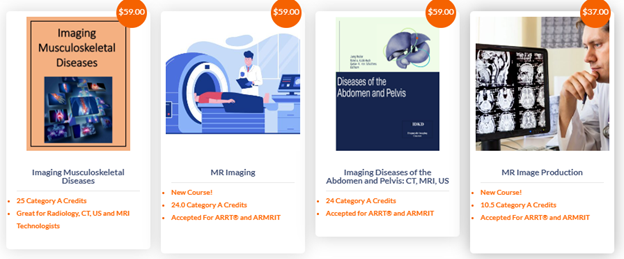
GetYourCEU: Earn MRI Credit
This platform offers accredited, clinically focused MRI CE courses that equip MRI professionals with practical skills needed throughout their careers to prepare for advances in new technology.
- Deliver up-to-date information on cutting-edge MRI technology.
- Provide recognized MRI credits accepted by ARRT and state licensing boards.
- Emphasize real-world application for immediate impact on clinical workflow.
- Offer flexible, online learning options tailored to the busy schedules of healthcare professionals.
These features make GetYourCEU a trusted platform for radiology professionals seeking not only to fulfill licensure requirements but to advance their expertise and career prospects in modern imaging technologies.
Mastering Whole-Body MRI from Training to Workflow
Successfully adopting Quantitative Whole-Body MRI entails a structured approach covering several key areas:
- Training and Certification: Complete accredited courses covering the technical, analytical, and reporting components of whole-body MRI. Achieve MRI credits required for licensure renewal and professional growth.
- Protocol Customization: Develop or adapt scanning protocols specific to your practice’s patient population and clinical demands. For example, optimize sequences for oncology staging, evaluation of metabolic syndrome, or cardiovascular assessments.
- Technology and Software Integration: Implement advanced MRI scanners and compatible software that efficiently process, analyze, and quantify imaging data across multiple organs.
- Workflow Optimization: Modify scheduling and patient management to accommodate longer whole-body scans while minimizing patient wait times and scanner downtime.
- Standardized Reporting: Create uniform report templates incorporating quantitative metrics, making findings clear and actionable for referring physicians.
Elevating Patient Experience with Innovation and Precision
While whole-body MRI captures extensive data, patient comfort remains a paramount concern. Innovations in scan sequence optimization and hardware design enable these sessions to be conducted more efficiently and with reduced patient repositioning compared to traditional multiple MRI appointments.
Moreover, the detailed quantitative parameters generated facilitate earlier and more confident diagnosis by providing reproducible, objective data. Emerging AI-based tools now assist in automating image quantification and interpretation, reducing reporting times and enhancing diagnostic precision.
How is Automation Shaping Whole-Body MRI’s Future?
Whole-body MRI is increasingly enhanced by technology trends such as artificial intelligence, automated organ segmentation, and multi-parametric mapping. These innovations:
- Improve diagnostic accuracy by standardizing analysis.
- Accelerate image processing and report generation.
- Enable radiologists to develop subspecialty expertise in advanced imaging techniques.
- Enhance personalized patient care through detailed, comprehensive imaging profiles.
Embrace Whole-Body MRI
Quantitative Whole-Body MRI marks a significant advance in radiology, enabling comprehensive, measurable imaging that enhances diagnostic precision and patient care. For MRI professionals, mastering this technology not only improves clinical outcomes but also supports continuing education and professional development.
MRI credit courses offer a practical, flexible pathway to gain expertise in MR imaging while earning essential CE credits. By embracing this innovation, radiology technologists can future-proof their skills in an increasingly data-driven medical environment. Advance your MRI expertise today with GetYourCEU’s accredited MRI courses.
Your Top Questions Answered: Demystifying Quantitative Whole-Body MRI
Q. What is Quantitative Whole-Body MRI?
It is an advanced MRI technique that captures detailed structural and functional data from the entire body in a single, efficient session, rather than through isolated regional scans.
Q. How does it improve workflow?
By consolidating scanning into one session with quantitative outputs, it reduces redundant imaging, minimizes patient visits, and enhances diagnostic accuracy through integrated multi-organ analysis.
Q. Is the scan comfortable for patients?
Yes. Optimized scan protocols and newer scanner designs reduce scan times and minimize the need for repositioning, thereby improving patient comfort compared to traditional multiple MRI scans.
Q. Why should I transition from traditional MRI scans?
Whole-body MRI provides comprehensive, quantitative data that improves diagnostic confidence, streamlines the imaging workflow, and offers better clinical insight in a shorter timeframe.