
Navigating the clinical landscape for sonographers and vascular technologists is more demanding than ever. Between managing high patient volumes, maintaining rigorous documentation standards, and staying abreast of rapidly evolving imaging protocols, the professional day is tightly packed. Within this high-pressure environment, continuing medical education (CME) often feels like an administrative hurdle rather than a clinical opportunity.
The challenge for the modern imaging professional is finding a balance: obtaining high-level, accredited education that provides real clinical value without requiring a week away from the clinic or a disruptive travel schedule.
The Shift Toward High-Value, Self-Paced Ultrasound Education
Traditional CME models, specifically live seminars and fixed-schedule webinars, are becoming increasingly incompatible with the realities of modern healthcare. When a department is short-staffed or a patient backlog grows, a sonographer cannot easily step away for a three-day conference. This has led to a significant shift toward structured, textbook-based online learning.
A smarter approach to ultrasound CME credits courses focuses on two primary pillars: Clinical Depth and Logistical Flexibility.
1. Clinical Depth Over Superficial Review
Generic click-through modules often fail to provide the nuance required for complex cases. High-quality CME should leverage comprehensive clinical texts that dive deep into pathology, hemodynamics, and advanced scanning techniques. This depth ensures that when a professional completes a course, they aren’t just checking a box for compliance; they are gaining insights that can be applied to the very next patient on their schedule.
2. Logistical Flexibility
The most effective CME fits into the interstitial spaces of a clinician’s life. This means having the ability to read a chapter during a lunch break, review vascular waveforms on a tablet at home, or study fetal biometry updates between cancellations. By utilizing e-book formats and online testing, professionals can chip away at large credit requirements without the stress of a looming deadline.
Core Specialties and Clinical Applications
Ultrasound is a highly specialized field, and CME should reflect that diversity. A one-size-fits-all ultrasound CME credits approach to imaging education is rarely effective. Modern platforms now offer specialized courses that allow professionals to target their specific areas of practice or expand into new ones to increase their departmental value.
● Abdominal and General Imaging
General sonography requires a constant refresh on atypical pathologies and evolving classification systems (such as TI-RADS or LI-RADS). Comprehensive courses provide the longitudinal study needed to recognize subtle tissue changes and improve reporting accuracy.
● OB/GYN and Fetal Imaging
With safety standards and fetal measurement protocols frequently updated, OB/GYN specialists need access to the latest evidence-based guidelines. Education in this sector focuses on everything from first-trimester screening to complex placental abnormalities.
● Vascular Technology
Vascular ultrasound is perhaps the most physics-heavy specialty. CME that focuses on Doppler principles, hemodynamics, and venous insufficiency helps technologists provide the detailed physiological data that surgeons rely on for treatment planning.
● Breast Ultrasound
As supplemental screening becomes the standard of care for dense breast tissue, the demand for high-level breast sonography has surged. Accredited courses help technologists differentiate between benign findings and those requiring biopsy, reducing unnecessary patient anxiety.
Strategy: Managing 30+ Credits Without the Burnout
One of the greatest stressors for imaging professionals is the triennial renewal cycle. Waiting until the final six months to earn 30 or more credits leads to rushed learning and cramming, which offers zero long-term retention.
The Chapter-a-Week Method
By selecting a 20-credit course based on a clinical textbook, a sonographer can commit to reading one chapter per week. This approach:
- Reduces cognitive load.
- Allows for real-time application (reading about carotid stenosis on Tuesday and applying that knowledge in the lab on Wednesday).
- Eliminates the renewal panic at the end of the cycle.
Enhancing Professional Growth with GetYourCEU
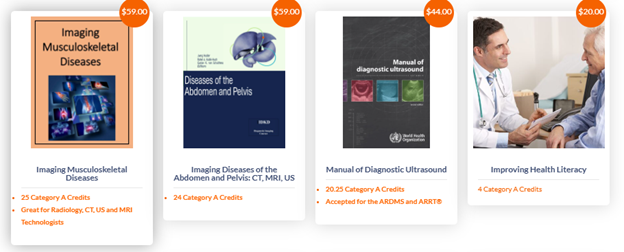
When selecting a provider, the choice should be dictated by accreditation and ease of use. GetYourCEU serves this need by providing high-quality, textbook-based courses that are specifically designed for ARDMS and ARRT dual-certification holders. By focusing on comprehensive e-books rather than fragmented snippets of information, the platform ensures that the education provided is both substantial and scientifically rigorous.
The process is designed for the digital age: professionals can choose a course focused on their specialty, study the material on their own terms, and take an online post-test to generate their certificate immediately. This eliminates the wait times associated with traditional mail-in formats and ensures that compliance records are always up to date.
The Career Dividends of Consistent Learning
The benefits of high-quality ultrasound CME credits extend far beyond a certificate. In an increasingly competitive healthcare market, the professionals who stand out are those who can demonstrate a commitment to clinical excellence.
- Increased Diagnostic Confidence: There is a direct correlation between the depth of one’s education and their confidence when scanning a difficult patient or an unusual pathology.
- Professional Credibility: Maintaining a diverse and current portfolio of credits makes a technologist a more valuable asset to their lead sonographer and interpreting physician.
- Career Mobility: For those looking to move into management, clinical application specialist roles, or education, a track record of consistent, high-level CME completion is essential.
By choosing a partner like GetYourCEU, professionals ensure they are meeting the highest standards of the imaging industry while respecting their own time and work-life balance.
Final Thoughts for the Imaging Professional
Continuing education is the bridge between being a button-pusher and being a highly skilled diagnostic partner. While the pressure of a clinical schedule is real, the tools available today make it possible to stay at the forefront of the field without sacrificing personal well-being.
Focus on quality over quantity. Choose ultrasound CME credits courses that challenge your current knowledge base and provide you with reference material you can return to long after the exam is over. When education is integrated naturally into the professional workflow, it ceases to be a chore and becomes a cornerstone of a successful career in medical imaging.
With the right resources from GetYourCEU, the path to maintaining your credentials and enhancing your clinical skills is clearer and more accessible than ever before.