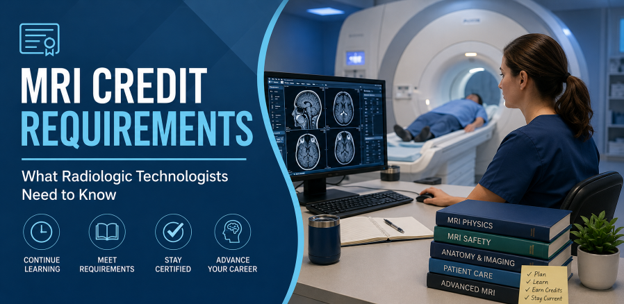
Keeping an MRI certification active takes more than passing an exam once and moving on. Radiologic technologists working in MRI are expected to keep learning throughout their careers, and that learning is measured in continuing education hours.
If you are new to the field or simply want a refresher, understanding how MRI credit requirements work can save you time, stress, and last-minute scrambling. This guide breaks down what counts, how often renewal happens, and how to choose courses that actually fit your life.
Why MRI Credit Hours Matter for License Renewal
Continuing education is not just paperwork. It exists because imaging technology, safety protocols, and clinical best practices keep changing, and technologists need to stay sharp on all of it. Renewal requirements make sure that every practicing technologist has reviewed current material within a set period of time, rather than relying only on what they learned years ago in school.
Falling behind on these hours can create real problems. A lapsed certification can affect your ability to work, and scrambling to finish credits right before a deadline usually means rushing through material instead of actually learning from it. Staying ahead of your requirements protects your credential and, just as importantly, keeps your clinical knowledge current.
What Counts Toward MRI Credit
Not every course or seminar automatically qualifies. Generally speaking, accepted coursework needs to come from an approved provider and cover material relevant to the modality you are certified in. For MRI specifically, that usually means content addressing imaging principles, safety in the MR environment, patient care during exams, or clinical applications across different anatomical areas.
Some organizations also have naming requirements, meaning a course needs to clearly reference MRI in its title or description to be counted toward MRI-specific renewal. This is worth double-checking before you commit to a course, since a broad imaging class may not satisfy a modality-specific requirement even if the content overlaps.
A few categories of coursework commonly apply toward this requirement:
- Foundational courses covering MRI physics and imaging principles
- Safety-focused courses addressing the MR environment
- Anatomy and technique courses for specific body regions
- Patient care and exam-experience courses
- Advanced topics such as MRI spectroscopy or specialized applications
How Often MRI Credits Need to Be Completed
Most certifying bodies work on a multi-year renewal cycle, commonly referred to as a biennium. Within that window, technologists are expected to complete a set number of continuing education credits before their renewal date arrives. The exact number can vary depending on your certification type and any additional state requirements that may apply.
Rather than waiting until the final months of the cycle, it helps to space coursework out over the full period. This spreads out both the cost and the time commitment, and it means you are less likely to be caught off guard by an approaching deadline.
Choosing Courses That Fit Your Schedule
Technologists juggle demanding shift work, so flexibility matters when picking coursework. Self-paced online courses tend to work well for this kind of schedule, since they can be completed in short sessions between shifts rather than requiring a full day away from work.
When selecting courses, a few practical questions can help:
- Does the course topic align with your current clinical role or areas you want to grow in?
- Is the course length realistic given your available free time?
- Does the price fit comfortably within your budget for the renewal period?
- Is a certificate issued immediately upon completion for your records?
Answering these questions before enrolling helps avoid picking courses that end up sitting unfinished.
In-Person vs Online MRI Credit Courses
Both formats have a place, depending on your learning style and availability. The table below outlines some general differences technologists often consider.
| Factor | In-Person Courses | Online Courses |
| Scheduling flexibility | Fixed dates and locations | Complete on your own timeline |
| Typical cost | Often higher due to venue and travel | Generally lower, no travel required |
| Certificate turnaround | May take time to process | Often available immediately after passing |
| Networking opportunities | Face-to-face interaction with peers | Limited, though some offer discussion boards |
| Best suited for | Hands-on or lab-based training | Theory-based and review coursework |
Neither format is universally better. Many technologists mix both, using online coursework for routine renewal and reserving in-person sessions for hands-on skills they cannot practice through a screen.
Common Questions About MRI Continuing Education
A few questions come up often enough that they are worth addressing directly.
- Do all courses count equally toward renewal?
No, credit values differ by course, so it helps to check how many credits each one provides before enrolling.
- Can credits be carried over into the next renewal period?
No, you cannot carry credits into the next renewal period.
- Is a certificate required as proof of completion?
Yes, technologists are expected to keep documentation showing a course was finished and passed.
- Does every course satisfy every state’s requirements?
Requirements can vary by state, so it is a good idea to review your own state’s rules alongside your certifying body’s requirements.
Keeping Track of Your Credit Hours
Losing track of completed coursework is a common and avoidable problem. A simple system can prevent last-minute panic when a renewal deadline approaches.
- Keep a dedicated folder, physical or digital, for every completion certificate you earn
- Note the date each course was completed alongside its credit value
- Check your running total against your renewal requirement periodically, rather than only at the end
- Set a personal reminder well ahead of your actual renewal date
This kind of simple recordkeeping turns a stressful annual scramble into a manageable, ongoing habit.
Staying Current as Technology Changes
MRI technology continues to evolve, from imaging techniques to safety protocols in the MR environment. Continuing education is not only a box to check for renewal purposes. It is also one of the more reliable ways technologists stay familiar with changes that directly affect daily practice.
Technologists who treat their coursework as genuine professional development, rather than a formality, tend to feel more confident handling newer imaging techniques and less thrown off when workplace protocols shift. Choosing courses that reflect real interest in your specialty pays off well beyond the renewal deadline itself.
Platforms like GetYourCEU offer a dedicated MRI credit course selection covering these exact topics, making it easier to plan coursework around genuine learning goals rather than convenience alone.
Conclusion
Meeting MRI credit requirements does not need to be overwhelming once you understand what counts, how often renewal happens, and how to fit coursework into a demanding schedule. Spacing out learning across your renewal period, tracking completed hours carefully, and choosing courses aligned with your clinical interests all make the process smoother.
GetYourCEU provides a straightforward way to explore relevant coursework, helping technologists stay current without unnecessary stress along the way.